- AI visibility is not the same as business impact because being mentioned does not necessarily mean influencing customers or generating revenue.
- Brand recognition is different from brand discovery because being named by users is not the same as being recommended by AI.
- AI can influence buying decisions even when it does not generate a measurable website click.
- Diagnose the real visibility gap before investing in more content or GEO efforts.
- Measure AI across access, representation, discovery, action, and business value rather than relying on a single visibility score.
Your brand appeared. So did the answer. The session ended.
Three things happened. Only one of them is in your report.
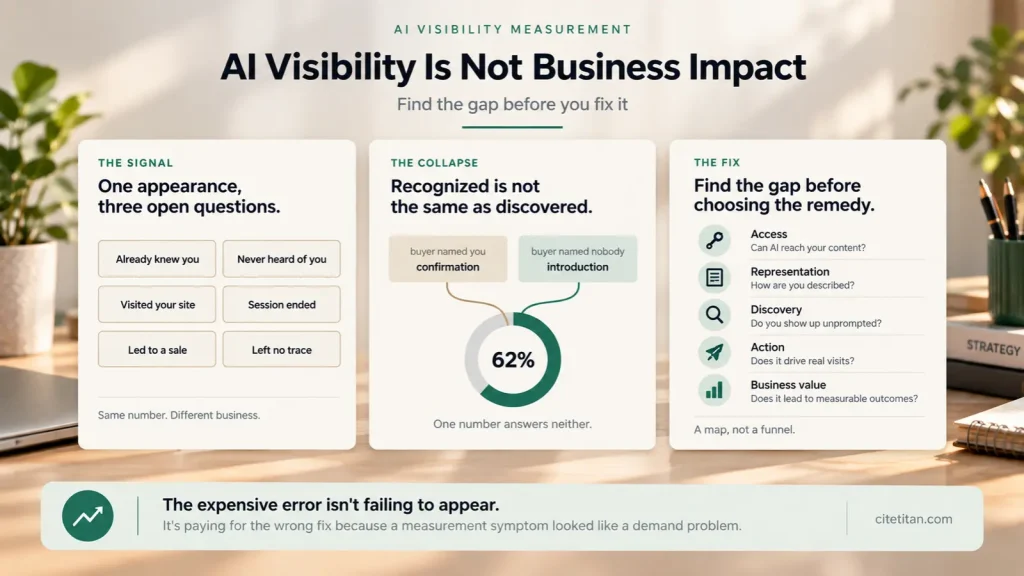
The same signal describes different situations. A user who already knows you and receives confirmation is not the same as a prospect who has never heard of you and just got introduced. An appearance that sends someone to your website is not the same as one that satisfies their question and closes the session. A mention that eventually contributes to a sale is not the same as one that leaves no observable trace. These aren’t variations on a theme; they’re different business conditions that call for different responses.
The strategic error isn’t optimizing for AI visibility. It’s treating visibility as a precise enough description of progress to justify investment before establishing what kind of visibility you’re actually looking at.
An unclicked answer is not one kind of outcome
When an AI summary appears in search results, users are considerably less likely to click a traditional result than when no summary appears, and the links cited inside the summary are clicked even less. Pew Research put that at 8 percent of visits with a summary present against 15 percent without, and about 1 percent for links inside the summary itself. The observation is real. What it means for a given business depends entirely on what the appearance was supposed to accomplish.
What click data doesn’t show is whether the exposure shaped a decision made later on another channel, whether the user’s need was met or the session simply ended, or whether no-click means the task is complete or interest is lost. None of that downstream influence is visible in click data, and treating an observation as a diagnosis is where the errors begin.
A publisher whose revenue depends on page visits faces a direct consequence when clicks fall; the economics are immediate. A B2B company with a long sales cycle and a recognized brand may get exactly what it needs from an unclicked answer: accurate representation during the research phase, even when that exposure produces no visit. The same click rate, two entirely different situations.
The click absence is where the diagnosis starts, not where it ends.
Being recognized is not the same as being discovered
When a user names your brand in a prompt, the system is responding within an already established brand context. When a user describes a problem or category without naming anyone and your brand appears, the system has introduced it into that conversation for the first time.
Both show up in visibility reports. Aggregated, they look like the same thing.
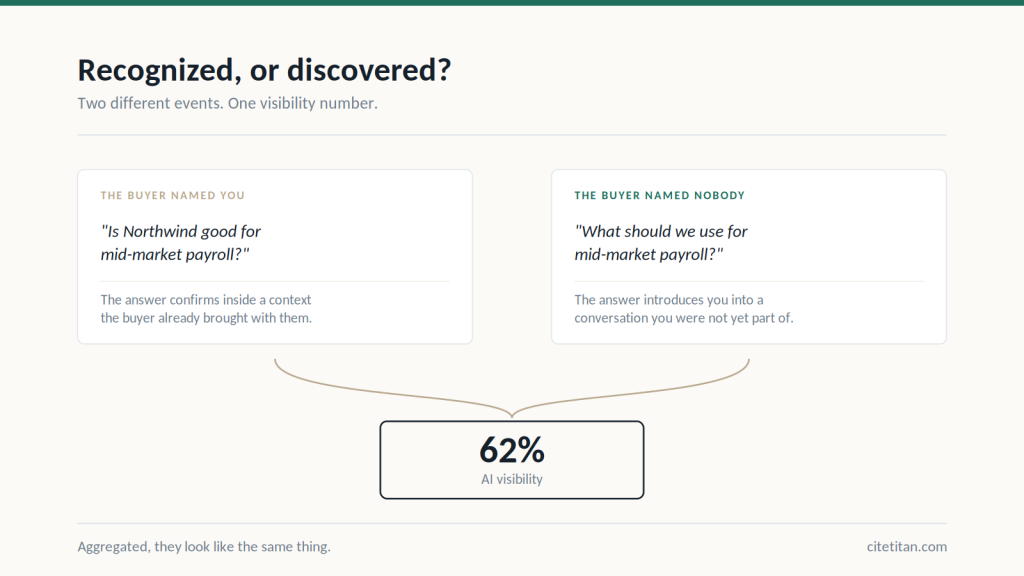
The gap between the two is sharp enough to matter commercially, and collapsing them produces a number that answers neither question cleanly.
Branded retrieval has genuine value. If a buyer is already considering you, appearing accurately in response to a direct query supports their process. But it doesn’t tell you whether AI is bringing new buyers into your orbit or serving ones who were already there through other means.
A visibility report can show strong numbers while a discovery gap goes unexamined. The report is accurate. The picture it creates is incomplete.
From accessible to decision-ready
Being retrievable and being understood as the right choice for a specific situation are two different things, and closing the first gap doesn’t automatically close the second.
Consistent naming, clear service descriptions, and accessible information give AI systems better material to work with. But even when a business is accurately described, a compressed answer risks foregrounding what two providers have in common, while the qualifications that separate them don’t always survive. Implementation requirements, minimum engagement size, and the kinds of situations each provider actually handles well are the details that determine fit, and they’re also the details most vulnerable to being lost.
Two professional services firms both offer the same category of service. Both are well-represented in AI outputs. What separates them in a real buying decision is the implementation timeline, required resources on the client side, and the complexity of situations each is built for. One suits a lean team running a rapid deployment. The other suits an enterprise governance process that runs considerably longer. That distinction is what makes either of them the right answer for a specific buyer, and it’s the kind of information that gets lost when legibility is the goal rather than suitability.
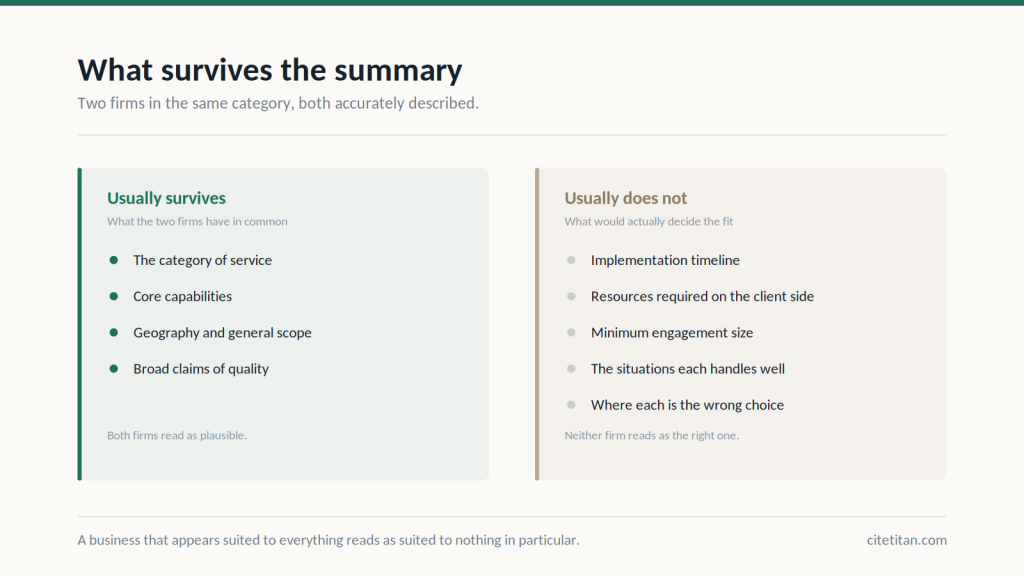
The audit question isn’t whether AI systems can retrieve information about your business. It’s whether what AI systems retrieve makes your fit, including your limitations and trade-offs, legible to a buyer who needs to understand them. A business that appears suited to everything tends to read as suited to nothing in particular.
What is visibility supposed to produce?
The business value of an AI appearance is not uniform across business models, and treating it as though it were is an easy mistake to make.
For a publisher whose economics depend on page visits, an unclicked appearance doesn’t directly replace the lost visit or its associated revenue. A B2B company selling a complex solution at a high contract value may care almost nothing about referral traffic; what it needs is to appear in the research conversations buyers have before they ever contact a vendor. A merchant selling consumer goods needs a path from recommendation to transaction that fits both the product and the buyer’s decision process.
The ecommerce evidence is instructive here and bounded. A study of 973 ecommerce sites found that ChatGPT referral traffic converts above paid social but below other established channels, including email, organic search, and affiliates, with outcomes stronger in categories where the purchase requires real deliberation. Its share of total traffic stayed under 0.2 percent. Other studies using different samples and definitions report ChatGPT referrals converting above organic search, which is itself a reason to check which measurement a given number came from. Either way, those findings are about ecommerce referrals. They don’t extend to unclicked exposure, to B2B consideration cycles, or to what AI visibility means for a media business.
One further limit worth holding: last-click attribution cannot capture upper-funnel contributions. Any channel that primarily serves the research and consideration phase will be understated by it. Knowing that going in shapes what you measure and how far you push the conclusions.
Which outcomes count as success is a decision that has to come before the choice of visibility metric, not after.
Diagnose the gap before choosing the intervention
A company appears frequently when someone searches for it by name and rarely when someone asks a category question without naming anyone. The reflex is to produce more content, and it can arrive before the question it’s meant to answer.
The same observation has several plausible explanations, each pointing somewhere different:
- The brand has strong recognition but weak category association: buyers know the name but don’t reach for it when forming a category-level question. This may indicate a gap between how the business describes itself and how buyers describe the problem they’re researching. That’s a positioning issue.
- The prompts being tested don’t reflect how buyers in this market actually talk about the problem. A different set of queries may produce a different picture. That’s a measurement issue before it’s anything else.
- The available information represents capabilities without making relevance to specific situations clear. The business is accessible but not yet decision-ready in the terms a buyer uses. That’s a framing issue.
- Platform and model variability is producing inconsistency that looks like underperformance. Different AI systems, different model versions, and run-to-run variability can all affect appearance rates. That’s a methodology issue.
- The sample is too small or unstable to support a reliable conclusion. That’s a data issue.
These explanations can coexist. The task is to identify which one drives the decision before committing to an intervention.
Consider what evidence would make one explanation more credible than its alternatives. Suppose the sales team confirms that prospects typically arrive already knowing the brand, but when buyers describe the problem or category they’re researching, they consistently use language the company doesn’t use in its own positioning. That is observable and testable. It makes the category-association explanation more specific than a general awareness gap, because it identifies where the disconnect may sit: between the buyer’s category language and how the company describes itself.
If that pattern holds, the next move is to examine how the business appears in category-context prompts and whether its capabilities connect to the terms buyers actually use. That’s an inspection, not an intervention. What the inspection finds determines whether anything changes and what.
If the language mismatch doesn’t hold across the relevant buyer segment, the diagnosis needs revisiting. Check whether the apparent brand recognition is concentrated among existing customers or a particular buyer role, rather than the broader segment being researched. The fork is determined by what the evidence shows, not by which intervention feels most familiar.
The result is a direction to investigate, not a conclusion to act on.
A useful way to work through it:
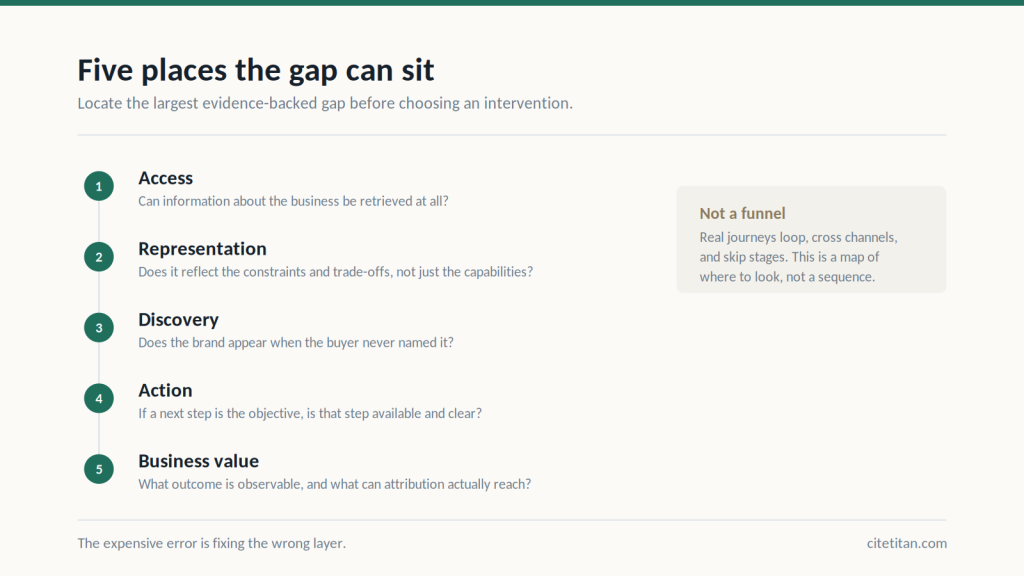
- Access: Can relevant information about the business be retrieved? Missing or inconsistent information is the clearest case for technical remediation. Establish that the access problem exists before treating it as the cause of a visibility gap.
- Representation: When retrieved, does the information reflect the business accurately, including its constraints and trade-offs, not just its capabilities?
- Discovery: Does the brand appear in category queries where the buyer hasn’t named it? This is where the gap between branded and generic performance lives, and where the distinction between a positioning issue, a framing issue, and a measurement issue actually matters.
- Action: When the business objective is to prompt a next step, is that step available and clear? If not, the issue may be in the conversion path rather than in visibility.
- Business value: What outcome is observable, and what does attribution look like given how this channel works? Given the attribution limit above, decide in advance what this channel can fairly be held accountable for.
Real buyer journeys don’t follow this sequence cleanly. They loop, cross channels, and skip stages. This isn’t a funnel; it’s a way to locate where the largest, most evidence-backed gap sits before committing to an intervention.
The most expensive error in AI visibility isn’t failing to appear. It’s investing in the wrong fix because a measurement symptom got mistaken for a demand problem.
Where the diagnosis leads
Not every AI appearance needs to produce a click or a conversion. And not every appearance earns its keep simply by occurring. The question is whether a given appearance plays a discernible role in a journey that creates value for the business and whether there’s enough evidence to know which role that is.
Identify the journey that matters for your business model. Define what success looks like in that journey, with its attribution limits acknowledged. Find where that journey breaks down and where the leverage is. Test one intervention with a defined way to know whether it worked.
That’s a harder question than “are we visible in AI?” It’s also the only one worth building a strategy around. Cite Titan helps you measure that gap: how AI systems represent your brand across the buyer questions that matter, scored by engine, tracked over time. See how it works.