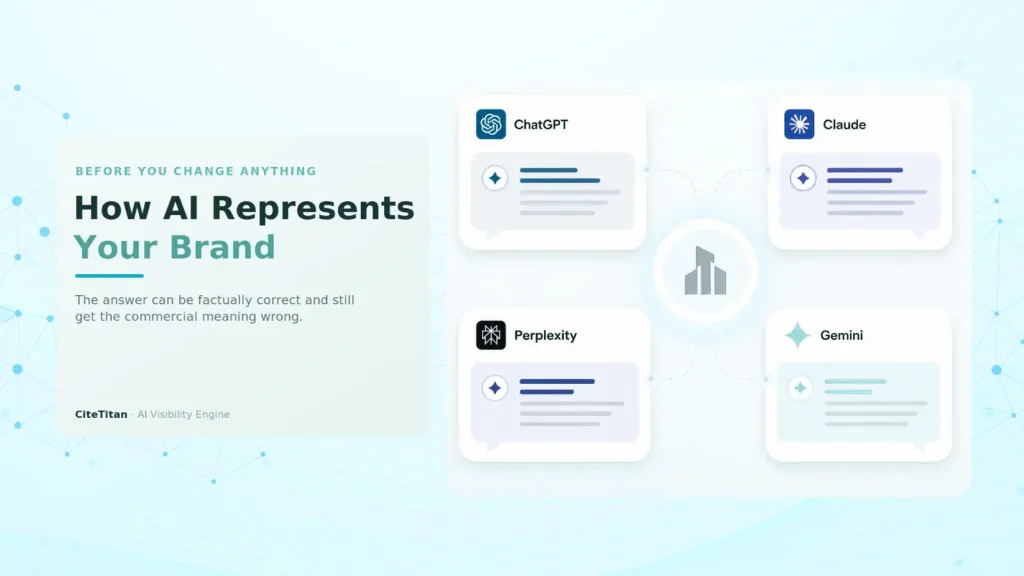
- An AI answer can be factually correct and still get the commercial meaning wrong.
- Positioning is what you intend; representation is what AI actually produces, and they diverge.
- Track the handful of real buyer-decision situations, not thousands of loosely chosen prompts.
- Rising visibility isn't a stronger position if the gains come from broad queries, not recommendations.
- Diagnose the cause before you change anything; the wrong fix compounds.
A company reads an AI answer about itself. Nothing in it is factually wrong. The product is described correctly, and the category is right. But the answer makes the company sound interchangeable with its competitors, and what makes it the right choice for a particular buyer isn’t there.
What’s unsettling isn’t the error. It’s that there isn’t one.
The same pattern can appear across buyer questions and AI systems: the facts hold while the commercial meaning shifts. A company known for something specific gets described as though it does what everyone else does.
Nothing was invented. Something was still lost.
That gap is harder to diagnose than a factual error and easier to misread. Knowing what’s actually causing it changes everything that follows.
When the Answer Is Technically Correct and Still Wrong
Factual correctness isn’t the same as sufficient representation.
An AI system can accurately describe what a company does while missing entirely why a particular buyer would choose it, and that gap can be the one that matters most at the point of decision.
The problem can take several forms: a company reduced to something generic, associated with a use case it doesn’t compete on, or framed with a competitor as the reference point and itself as the alternative worth considering. In each case, the facts hold. What doesn’t hold is the representation that would make the answer useful to someone deciding.
The standard isn’t whether AI repeats preferred positioning. It’s whether the representation is accurate, relevant, and complete enough for the context in which a buyer is deciding and whether it preserves what actually affects the decision. Before changing anything, that standard has to be applied to what the AI is actually producing.
The Gap Between What You Intend and What AI Produces
Positioning is what a company intends to own; representation is what an AI system produces about that company for a specific user in a specific context, and the two can diverge in ways the company doesn’t always see coming.
Search-enabled AI systems can draw on a wide information environment beyond your own properties, including third-party sources such as reviews, trade coverage, and other descriptions of the company and category. That material doesn’t always agree with itself. A company that has carefully refined its messaging may find that outside sources still carry older descriptions, customer framings that differ from internal ones, or competitor positioning that has shaped how the category is understood.
Different information environments can contribute to different representations, but the evidence doesn’t support a precise claim about how any individual source influences any specific output; that causal chain runs through model internals that aren’t observable from the outside.
The question that gets skipped: is AI misunderstanding you, or are you asking AI to reflect a positioning the available evidence doesn’t support?
Sometimes a company describes itself one way, customers describe it another, and independent sources describe it a third. An AI producing a representation that doesn’t match the brand’s preferred language isn’t necessarily failing in that situation. It may be reflecting an inconsistent set of descriptions, and those descriptions may be what need attention before the output itself does.
Making a distinction more explicit in your own content may make it easier for AI systems to identify and reproduce. Distinctions that depend heavily on implicit or experiential context can be harder for AI systems to identify and reproduce than explicit, utilitarian ones.
A company known among its customers for the judgment and specialization surrounding its work may find its website describes that work in terms any competitor could claim. What customers understand and what those sources contain are two different things, and that gap can shape what AI systems represent. Which distinction should be made clearer, and which would lose something important in the translation, is a strategic judgment, not a content production decision.
The Buyer Context Is the Unit That Matters
Not every purchase decision looks the same, and AI representation can shift with it. A company can appear consistently when buyers ask what its category is and become much less visible when the question becomes which vendor is best for a specific use case.
Those aren’t one AI visibility problem: they don’t necessarily share the same cause, and averaging them into a single number can obscure both.
The useful starting point isn’t an abstract prompt taxonomy. It’s the recurring situations in which buyers actually compare, evaluate, or choose from real purchase questions, sales conversations, competitive evaluations, and product-selection decisions. The same brand can appear in category discovery, disappear from recommendation, surface in a comparison or lose it, and be strongly associated with one use case while being invisible in another. These reflect different buyer decisions at different stages and may call for different interventions.
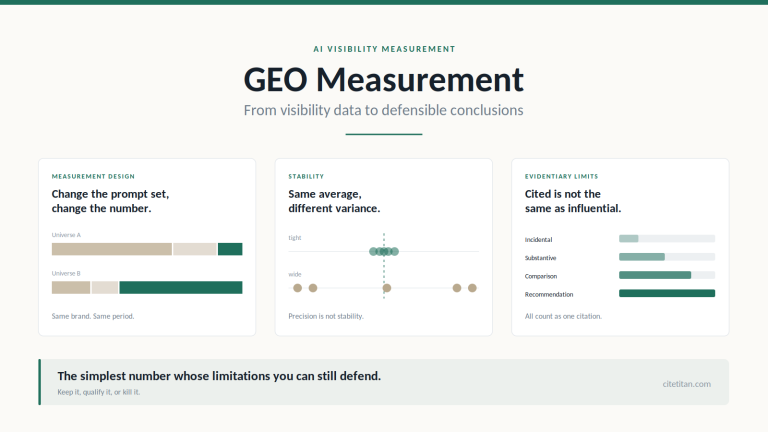
Query intent can produce significant variation in how AI systems represent brands, but it isn’t the only source. Representation can shift across models, platforms, retrieval states, and repeated runs of identical prompts. A single prompt is an observation, not a stable measurement of brand position.
The bigger mistake isn’t running too few prompts. It’s treating prompts as independent measurements when many are different expressions of the same underlying buyer decision. Ten thousand loosely chosen prompts may tell you less than carefully examining the handful of situations where buyers are actually deciding and where AI representation affects whether your company is in the conversation at all.
Visibility Is Not Position
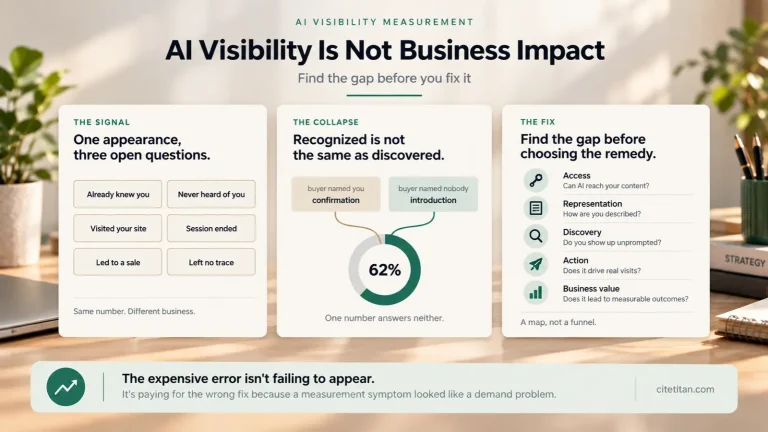
AI visibility went from 24% to 38%. The dashboard looks better.
But when someone examines the answers, the brand is appearing in broad informational queries, while competitors dominate comparison and recommendation contexts, the ones where buyers are often closest to a decision. The number moved. Nothing commercially may have changed.
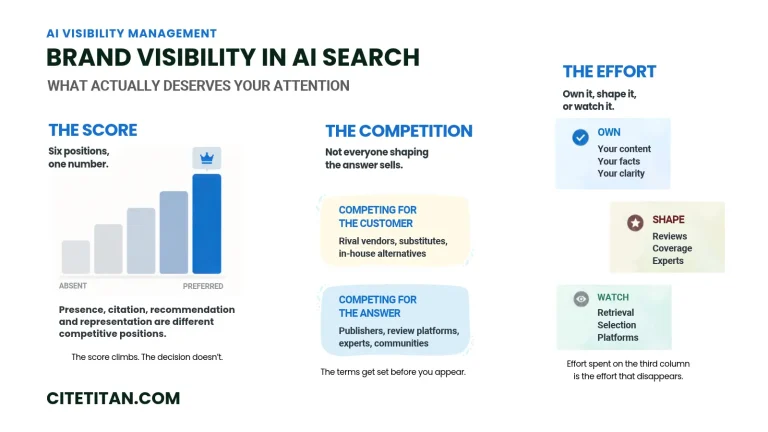
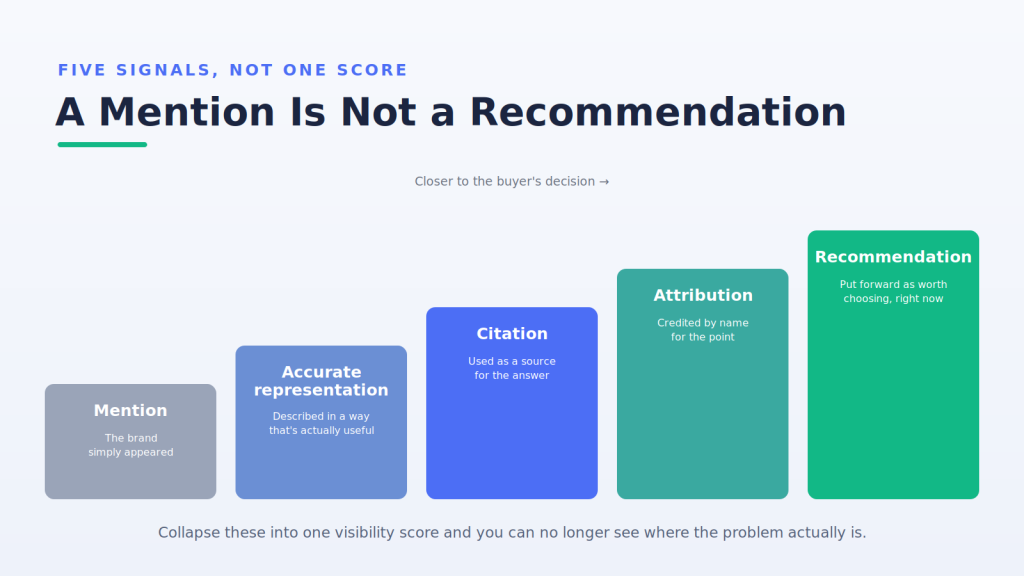
A mention, an accurate representation, a citation, an attribution, and a recommendation tell you different things. Collapsing them into a single visibility score produces a number that may not correspond to any buyer experience worth tracking on its own.
| Signal | What it means | What it alone doesn’t tell you |
|---|---|---|
| Mention | The brand appeared in the answer | Whether it was accurate or useful |
| Accurate representation | Described in a way a buyer can actually use | Whether it was preferred over rivals |
| Citation | Used as a source the answer draws on | Whether it was recommended |
| Attribution | Credited by name for a specific point | Whether it won the decision |
| Recommendation | Put forward as worth choosing, in context | Whether it’s truly the best answer (this is system framing, not market truth) |
A mention means the brand appeared. A recommendation means the AI presented the brand as worth considering for a specific decision. The distance between them is often where the problem lives; a metric that doesn’t distinguish between them can’t locate it.
AI recommendation isn’t market truth. A system can favor a brand that isn’t the category leader, while different systems can produce different competitive outcomes for identical queries. What AI recommendation tells you is how that system is framing the competitive set in a given context, not which company is the better answer.
If your brand appears more often but is recommended less often where buyers are deciding, visibility went up while your position in those situations may have weakened. A dashboard tracking appearance would call that progress.
Diagnose Before You Touch Anything
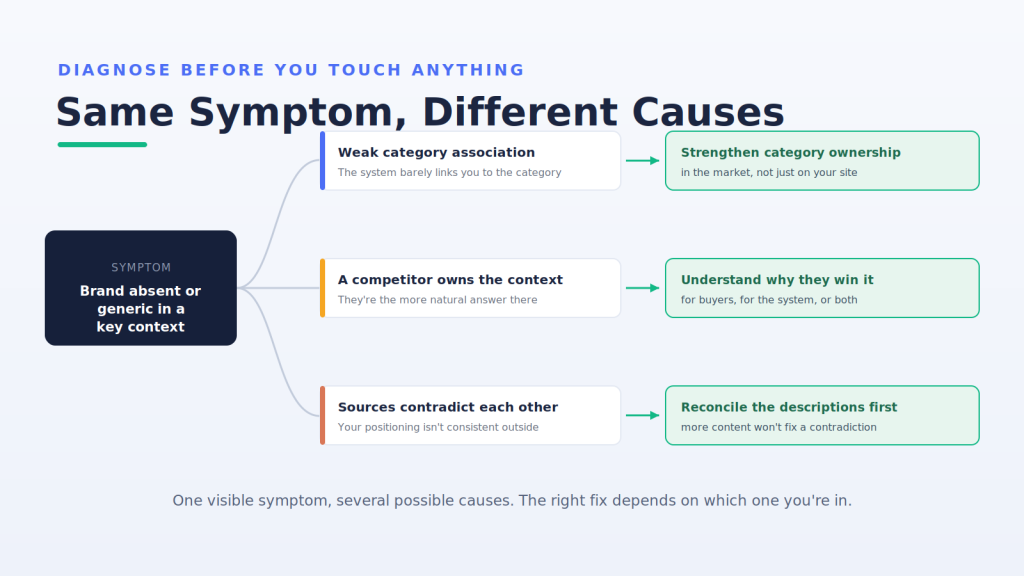
A bad intervention is recoverable. An intervention applied to the wrong diagnosis compounds with every step that follows.
The same visible symptom can have multiple causes, and the right response depends on what’s causing it. A brand that doesn’t appear in a relevant context might be absent because its category association is weak, a competitor holds that context more strongly, or the query isn’t one where the brand is the right answer. Treating them as one problem can produce solutions that move metrics while leaving the situation unchanged.
When AI gets facts wrong, investigate possibilities such as first-party inaccuracies, outdated information, contradictory external descriptions, and entity confusion before assuming more content will fix it.
When AI is accurate but generic, ask whether that’s an information problem or a differentiation problem because additional accurate information won’t resolve insufficient distinctiveness.
When competitors win a context repeatedly, ask what makes them the more natural answer in that situation for buyers, for the system, or both.
And when the available market evidence consistently places the company somewhere other than the category it wants to own, ask whether that category is ownable and what would need to be true in the market, not just in content, for that understanding to take hold.
Every intervention carries a cost. Making positioning more explicit may flatten meaning that earns its value by being implicit. More content doesn’t automatically produce better representation if positioning is contradictory across sources; additional material may deepen the contradiction.
Are you improving the representation or improving the number that measures it?
What the Measurement Is Actually Telling You
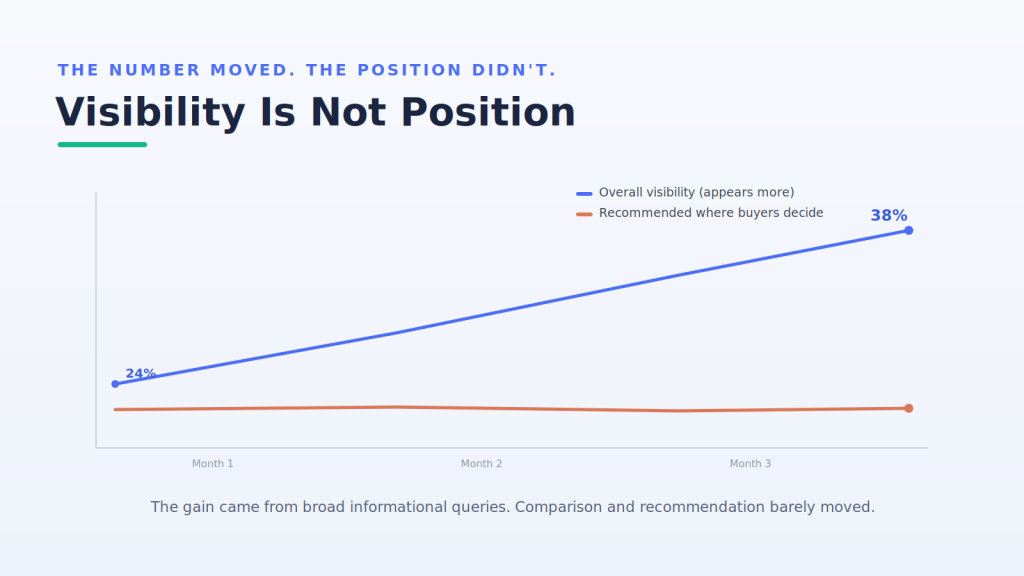
A dashboard can tell you the number moved. It can’t tell you whether the brand became more differentiated, more relevant to the decisions that matter, or simply more frequently mentioned in situations that don’t.
A score can grow more stable and more trustworthy-looking even as it becomes less useful for the commercial question you’re trying to answer. Three months of rising numbers looks like progress until someone examines the underlying answers and finds that the increase came from broad informational queries, while the comparison and recommendation situations, the ones tied to actual buyer decisions, barely shifted.
Precision and validity are different properties. A precise measurement can still be measuring the wrong thing. Validity means tracking the right observations for the right question, not just whether the brand appeared, but whether the representation was relevant, differentiated, and positioned for the decision the buyer was actually making. Precision without that is a more confident reading of the wrong instrument.
Track a consistent set of observations across the purchase situations that matter, such as:
- Did the brand appear?
- Was it accurate and differentiated enough to be useful?
- Was it cited, attributed, recommended, or displaced?
That gives you a better basis for judging whether something is shifting where it needs to; an aggregate score alone can’t tell you that.
Choosing what to measure is harder than scaling the measurement of the wrong thing.
What It Actually Comes Down To
The more useful question isn’t why AI isn’t saying what the company wants. It’s what the answer can reveal about the information environment, how the company is described outside its own properties, and whether the positioning it has invested in has taken hold beyond its own content.
That question may expose a problem that content alone can’t solve: inconsistent positioning across sources, weak category ownership, or simply a gap between how the company sees itself and how the market does. That’s why representation is worth understanding before it becomes another number to improve.
A better number does not mean progress if the buyer is still being told the same thing.
For more on AI visibility, measurement, and the decisions behind the numbers, explore the CiteTitan blog.
Frequently Asked Questions
Is a technically correct AI answer good enough?
Not necessarily. Factual correctness isn’t the same as sufficient representation. An AI answer can describe what a company does accurately while missing why a particular buyer would choose it, and that missing piece is often what matters most at the point of decision. The standard to apply is whether the representation is accurate, relevant, and complete enough for the context in which a buyer is actually deciding.
Does higher AI visibility mean a stronger position?
Not on its own. A visibility score can rise because a brand appears more often in broad informational queries, even as competitors continue to dominate the comparison and recommendation contexts where buyers are closest to a decision. Appearing more is not the same as being recommended where it counts, so a rising number can accompany a weakening position in exactly the situations that drive revenue.
How many prompts should I track?
Volume is not the point. A single prompt is an observation, not a stable measurement, because representation shifts across models, platforms, retrieval states, and even repeated runs of the same prompt. Ten thousand loosely chosen prompts can tell you less than carefully examining the handful of real situations where buyers compare, evaluate, and choose, tracked consistently over time.
Should I change my content as soon as an AI answer looks wrong?
Diagnose first. The same symptom, such as a brand appearing generic or absent in a key context, can have very different causes: weak category association, a competitor owning that context, or inconsistent descriptions across sources. An intervention applied to the wrong diagnosis compounds with every step that follows, and more content can deepen a contradiction rather than resolve it.