- AI visibility is about being recommended for the right customer questions—not simply being mentioned more often.
- Measure AI visibility by specific services, scenarios, and locations rather than relying on one overall visibility score.
- Your website alone doesn’t define how AI understands your business—reviews, directories, and third-party sources matter too.
- More content won’t fix unclear positioning; you first need to identify what signals are causing AI to misunderstand your business.
- The best long-term AI strategy is to create a consistent, specific, and corroborated digital footprint across the web.
Before asking whether a business is visible in AI-mediated discovery, ask what it needs to be visible for. Local AI visibility starts with that question, not with a content audit.
A customer asking an AI which contractor handles emergency commercial refrigeration for restaurants may not be getting a conventional list of pages and results to evaluate.
AI experiences can synthesize information from multiple sources into a response built around the question being asked. They don’t always produce the same result, and the businesses they surface can vary.
Much of the information available through conventional search can also be drawn on through AI-mediated discovery. The systems don’t necessarily use it the same way, but the underlying information environment still matters. Conventional SEO doesn’t become irrelevant. It remains the foundation beneath a different problem.
For many businesses, that problem isn’t new. The gap between what a business wants to be known for and what the available information actually says about it has been there all along.
AI-mediated discovery doesn’t necessarily create it. It can bring the consequences of that gap into view in a context where the business may have less visibility into what’s happening and less ability to see what opportunities it may be missing.
The measurement problem
A representation problem and a visibility problem look similar from the outside. Both can show up as weak AI presence. Both can appear to call for the same interventions. Standard visibility measurement can struggle to distinguish between them.
Tracking what percentage of monitored prompts return the business somewhere in a response tells you something about exposure. It doesn’t tell you whether the business is being understood as relevant to the specific need being asked about.
Search produced a position. Position was the output, so measuring position made sense. The instinct to measure a single visibility number carried into AI tracking, which would be fine if AI produced stable positions. It produces responses, and a business can appear in one the way a name appears in a list, the way a candidate appears on a shortlist, or the way an answer appears to a question.
A monitoring score that doesn’t distinguish between those three situations can collapse mention, consideration, and recommendation into one number and report it as visibility.
The type of question can materially affect which sources get cited. Recommendation queries and explanatory queries can show different source-selection patterns, with recommendation queries more likely to draw on provider or comparison sources and explanatory queries more likely to draw on informational content. One citation audit of a single AI platform found that booking and comparison platforms supplied roughly 69 percent of cited sources when a hotel query was framed as a booking request, and roughly 44 percent when the same need was framed experientially.
A business tracking aggregate AI visibility across query types is averaging materially different discovery situations, and that average can improve while the scenario driving revenue stays unchanged.
For service businesses, the consequences of that collapse are specific. A customer asking about commercial refrigeration contractors may be early in the decision process or already close to choosing. Either way, being present when they’re building a mental list of names worth investigating can put a business into the consideration set.
Being absent can make it less likely to be researched, even if the business would perform well once considered. Optimizing purely for recommendation, for being a named answer, is optimizing for a moment that may not reflect how customers in this category actually decide. Consistent presence when consideration sets form can be a stronger position than occasional prominence in the wrong context.
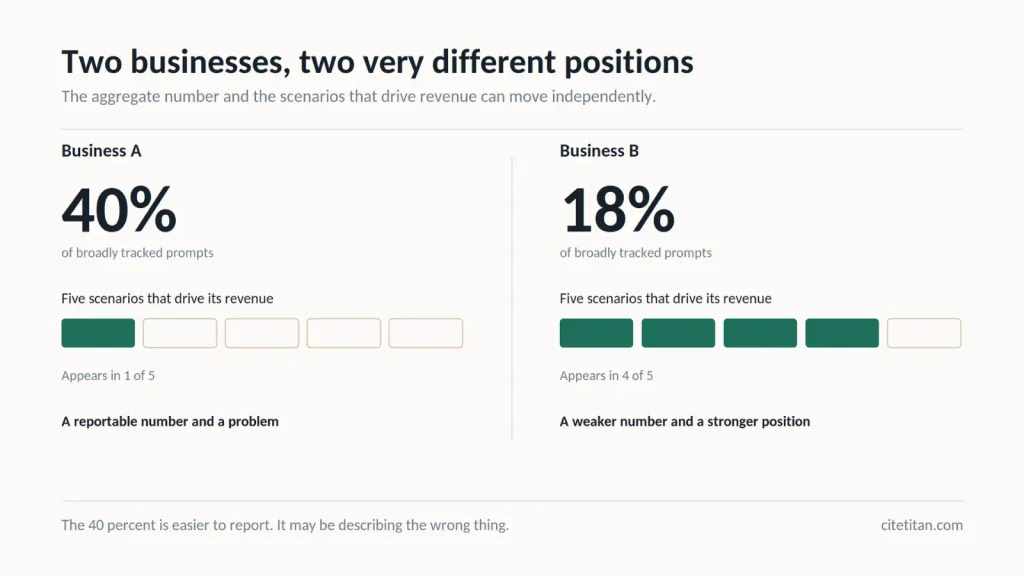
A business appearing in 40% of broadly tracked prompts but rarely in the five scenarios driving most of its revenue has a number and a problem. Another appearing in 18% but consistently when the right question gets asked may be in a stronger commercial position. The 40% is easier to report. It may be describing the wrong thing entirely.
What the information environment actually says
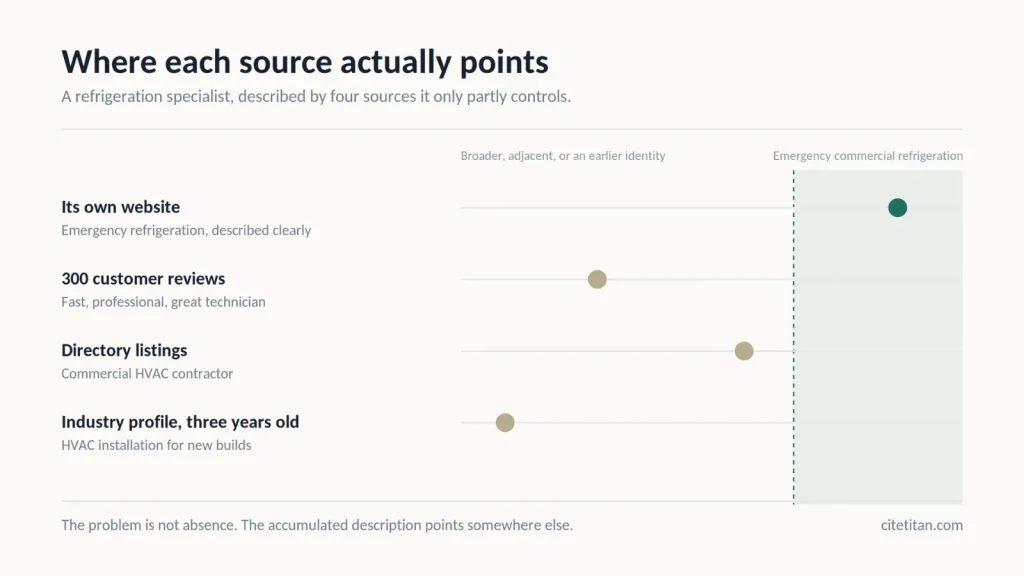
Consider a commercial refrigeration contractor with strong conventional local visibility, a substantial review base, and service pages covering emergency work. Its sales team starts reporting something. Prospects are mentioning competitors they found through AI recommendations. The business appears in AI responses. Just not the ones converting.
Not enough AI-focused content, the team decides. Service pages get added, along with FAQs and structured data. Monitoring subsequently shows overall AI visibility climbing.
Then someone segments the prompts by service type. The improvement is concentrated in broad HVAC queries. The refrigeration scenarios (emergency work, restaurant clients, after-hours calls) have barely moved.
A source audit follows. The business’s own website describes emergency refrigeration clearly. Reviews are strong on volume and rating.
But read the review language: fast, professional, great technician. Little describes the business specifically in the context of commercial refrigeration work. Directories list it under commercial HVAC contractor, with service categories that don’t mention refrigeration.
An industry profile from three years ago leads with HVAC installation for new commercial builds. The handful of external articles referencing the business discuss HVAC service response times. The external picture describes a version of the business that no longer matches where it needs to compete.
Three problems had been collapsed into a single visibility score: the measurement was too broad, the review language wasn’t reinforcing the specialization, and external sources were still describing an older identity.
Some of the content work had been useful. None of it had touched what the audit found, which was that the information surrounding the business, drawn from sources it only partially controls, was consistently describing something adjacent to the work for which it wanted to be considered.
The problem isn’t absence. The accumulated description points somewhere slightly different from where it needs to point.
A business can have 40 pages, 300 reviews, and consistent directory presence and still have this problem. Volume alone doesn’t resolve it. The question is whether the available information makes a specific association clear or leaves room for a different one.
Narrowing toward refrigeration specialization can mean accepting less emphasis on broad HVAC queries in exchange for stronger association with higher-value work.
Staying broad preserves addressable demand but can leave the specialization competing against businesses for whom it’s the primary identity. AI visibility doesn’t resolve that decision. It can make the cost of deferring it harder to ignore.
More of the same
The contractor’s team had done what teams often do: added content, added structure, and made the first-party information environment more specific. The audit showed why none of it closed the gap.
Content can demonstrate expertise and show that a business understands the problems its customers navigate. Service pages communicate capability, geography, and commercial scope.
Reviews contribute customer language describing real experiences, and that language either describes the business in a specific context, or it doesn’t. Different kinds of evidence do different work, and the gap in any given situation may be specific to one of them.
A business largely controls what it publishes about itself. It doesn’t control what independent sources say. When a trade publication mentions a contractor’s specialization, when an industry discussion names a firm in a specific context, and when a review describes the actual work rather than general satisfaction, those provide a different kind of description, one the business didn’t produce about itself.
That matters not because first-party information is inherently less credible, but because independent sources provide descriptions produced outside the business’s own interest in how it is described. A business is always a partial witness to its own relevance.
For the contractor, external descriptions weren’t absent. They were describing a version of the business that no longer matched its current specialization. Adding more first-party content alone wouldn’t necessarily shift that, and the gap between what the business published about itself and what independent sources said could stay just as wide.
Producing more of what already exists can simply reinforce the existing signal. If that signal is generic, more of it is more generic.
The diagnostic sequence
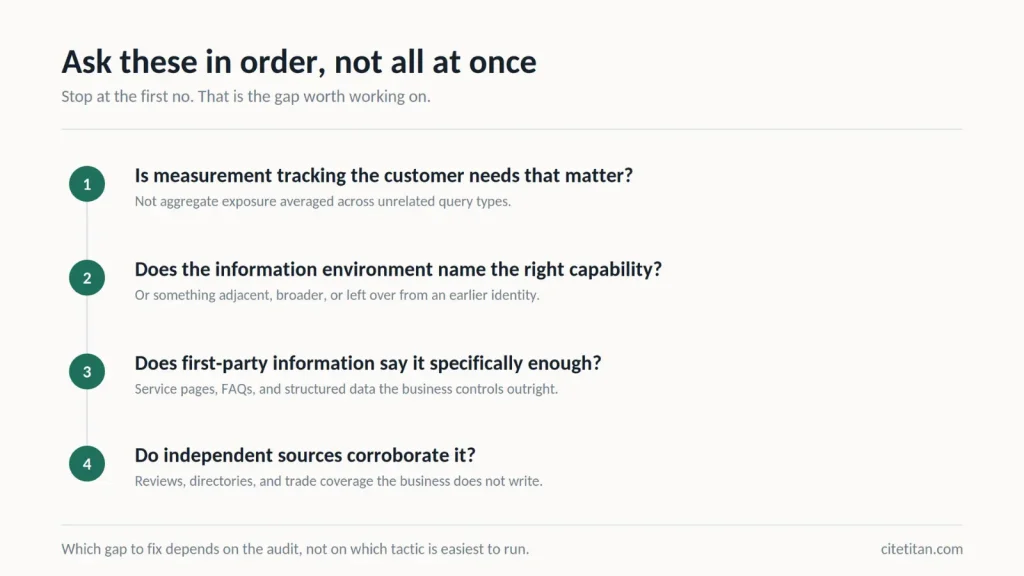
When local AI visibility is weak, the instinct is to ask what content is missing. It isn’t necessarily the right question.
- Is measurement tracking the customer needs that actually matter, rather than aggregate exposure across query types with little commercial relationship to each other?
- Does the information environment clearly associate the business with the specific capability for which it wants to be considered, rather than something adjacent, broader, or left over from an earlier version of what the business does?
- Does first-party information communicate that association specifically enough to be unambiguous?
- Do independent sources reinforce it, rather than describing something different from what the business publishes about itself?
If the answer to any of those is no, that’s a gap worth examining first.
Which one to address depends on what the audit actually shows, not on which intervention is easiest to execute.
Diagnosis before tactic
Two businesses wanting identical outcomes may need entirely different interventions. One needs its positioning made coherent before external mentions can do their most useful work. The other has clear positioning, but independent sources don’t reflect it, and more first-party content alone doesn’t close that gap.
The same tactic applied to both can produce one reasonable result and leave the other no better off. Not because the tactic was wrong in itself, but because it was chosen before the problem was understood.
AI-specific optimization tactics and durable SEO infrastructure are not the same investment. Structured data, schema, and entity-focused work are worth doing.
But none of it substitutes for positioning that holds across the discovery contexts that matter. When the diagnosis is uncertain, build what doesn’t depend entirely on any single platform’s current behavior.
AI systems change with time. The need for a clear, well-grounded information environment is more durable.
What measurement should actually tell you?
Measurement specific enough to show what aggregate local visibility conceals earns its cost over time. Measurement too coarse to inform a decision is primarily a reporting exercise.
Third-party monitoring scores are generally built on observable outputs, specifically what appears in responses when certain prompts are run. They don’t directly measure what’s happening inside the platforms generating those responses. A score improving because broad category visibility improved while high-value scenario visibility stays flat is motion. Whether it’s progress depends on what the business is trying to achieve.
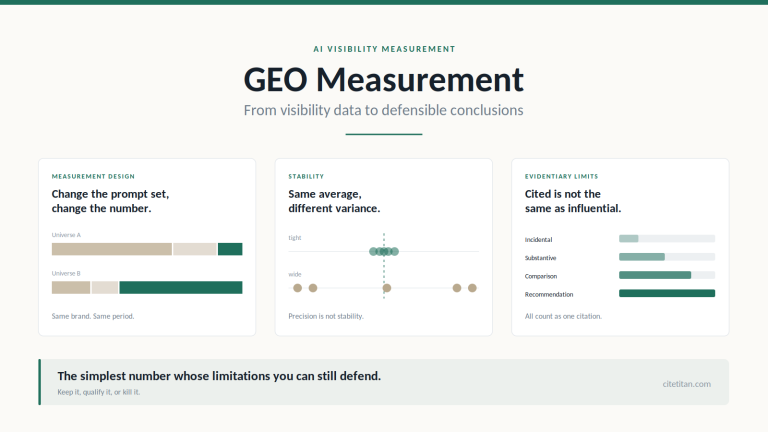
Visibility tracked by specific customer need, by service line, and by geography, and tested with enough repetition to account for natural variation in AI outputs, is a measurement that can inform a decision. A single prompt on a single day is a data point.
Running the same prompt repeatedly and reading the variance is closer to signal.
The distinction between mention and recommendation needs to be carried into measurement deliberately, because not every tool makes it automatically.
A business appearing in a general category response and a business named specifically for a high-intent query are in different commercial positions. Treating them as equivalent produces a number that describes the distinction poorly.
Whether it matters commercially is best assessed alongside qualified leads, calls, bookings, and other business outcomes. AI can sit earlier in the customer’s process, potentially closer to where consideration sets form.
Measurement that never connects to those outcomes can’t tell you whether changes in visibility are translating into commercial results.
When local AI visibility is really a representation problem
When AI visibility is weak and the information environment is full, adding more information isn’t necessarily the answer. The question is whether what’s already there consistently communicates the association with which the business wants to be considered.
When a business appears inconsistently, or not at all, examining whether the information environment presents a clear, corroborated picture of what the business does and where it fits, across the sources it controls and the sources it doesn’t, is worth doing.
That’s not a claim about how any particular system ranks businesses. It’s the question the contractor scenario keeps raising.
Conclusion
AI doesn’t change the requirement for clear, accurate, and well-grounded business information. In conventional search, many visibility problems could at least be observed through familiar ranking and search-performance signals. A weaker signal in AI-mediated discovery can mean being absent from contexts the business may not be monitoring, for needs it may not realize it’s missing. The feedback arrives differently, and it may arrive later than the problem.
Local AI visibility problems aren’t always visibility problems. The information available about a business can be abundant, and it still may not consistently communicate the specific associations that matter for the customer needs the business wants to win. AI systems synthesize what’s available, and a blurry or misaligned picture can show up not as a lower ranking, but as a different answer.
The better question for a business isn’t simply how hard it has optimized for AI, but whether its information environment, accumulated from sources it doesn’t entirely control, makes it a credible answer to the specific customer questions it wants to win.
Not necessarily the most visible. The most relevant when the question is asked.
The same logic applies everywhere a business gets found.
More on search, AI visibility, and how businesses get found and understood, on our blog.