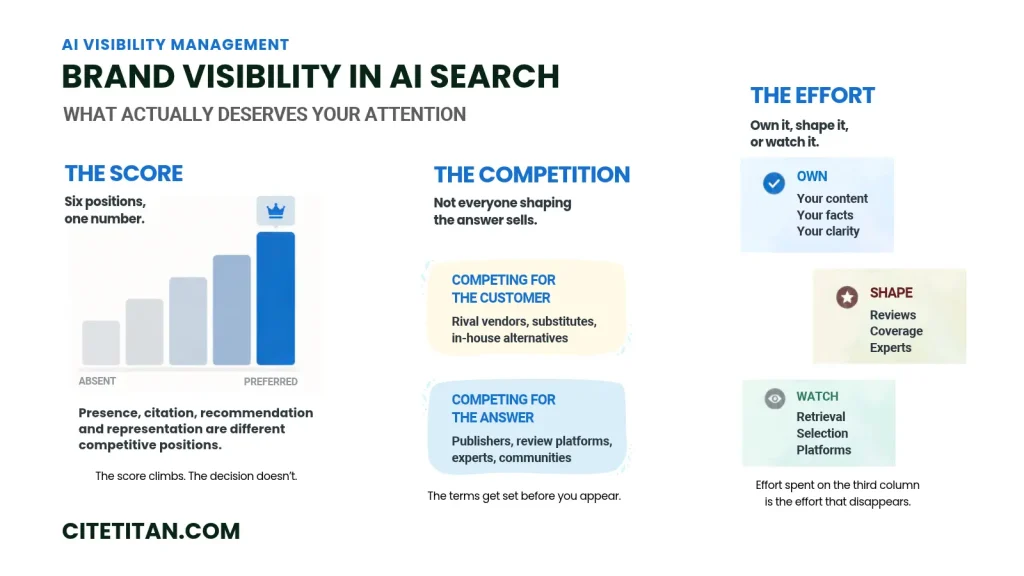
- A visibility score that collapses presence, citation, recommendation and representation into one number can climb while nothing changes commercially.
- Some of the entities competing for your answers don’t sell what you sell, and they decide which attributes the comparison turns on.
- A brand controls what it publishes, not how customers describe it or which category the market places it in, and confusing the two is where content budget disappears.
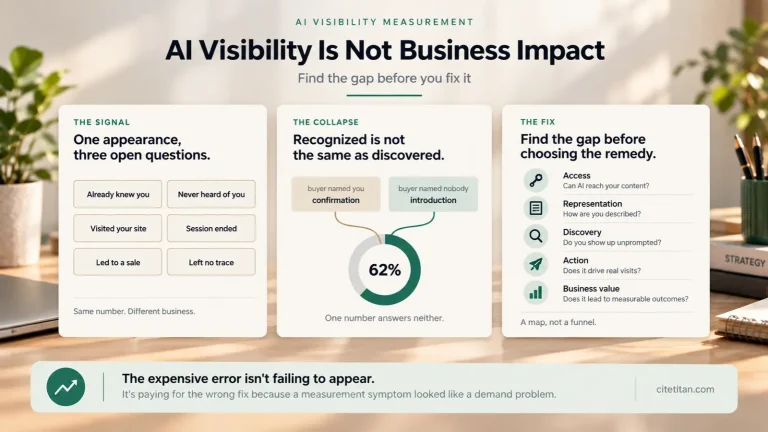
- Five different failures produce the same weak report, so the diagnosis has to come before the remedy.
- Build on useful information, clear positioning and credible independent coverage, because platform behavior and source preferences move without warning.
A brand’s AI visibility report looks better this quarter. Mentions and citations are up; the dashboard shows progress. But when the questions closest to purchase get tested, the brand may still be overlooked or described in ways that don’t reflect what it does or does best. The metric moved. The business didn’t.
As AI visibility becomes easier to measure, it also becomes easier to optimize the measurement rather than the outcome the measurement was supposed to represent.
This article is about what deserves attention, what doesn’t, and why.
AI visibility isn’t a ranking metric in disguise
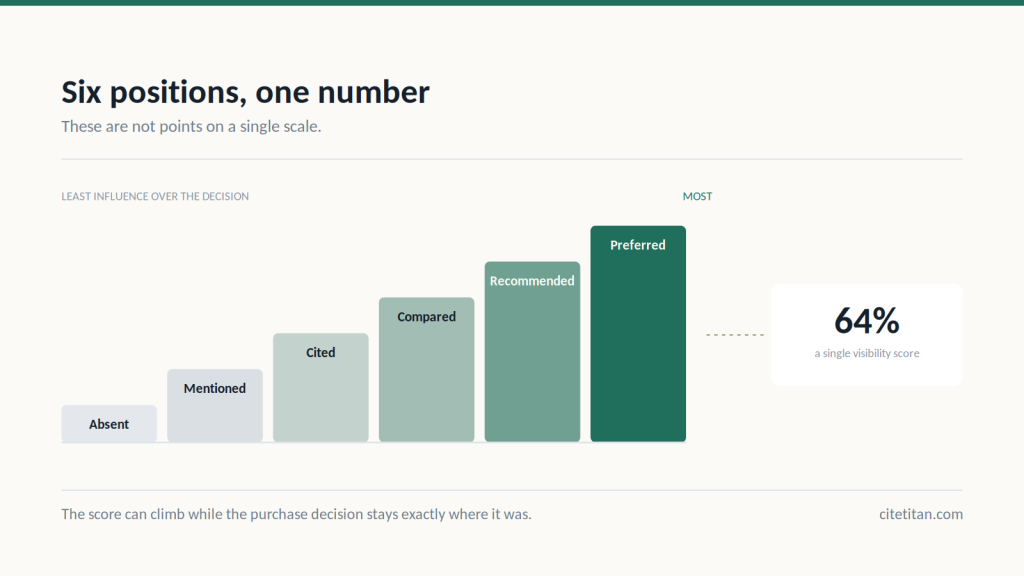
Being absent from an answer, mentioned in passing, cited as a source, included in a comparison, recommended for a specific use case, or preferred over alternatives for a high-intent question aren’t points on a single scale. They represent different competitive positions, different degrees of influence over a decision, and if they’re not where they should be, different problems requiring different responses.
A visibility score that collapses presence, citation, recommendation, and representation into one number can climb while purchase decisions remain unchanged.
A brand can get better at the proxy and see no corresponding change in revenue.
Frequency without purchase proximity
A brand can appear regularly across a broad category: general questions, informational queries, or tangential mentions, while barely registering in the answers people encounter when they’re deciding what to buy. The aggregate presence count looks healthy. Whether the brand is being recommended at the point where decisions get made is a question the aggregate count doesn’t answer.
The starting point isn’t how often the brand appears. It’s what role it plays when it appears and whether that role puts it in front of people making buying decisions.
The competition isn’t who you think it is
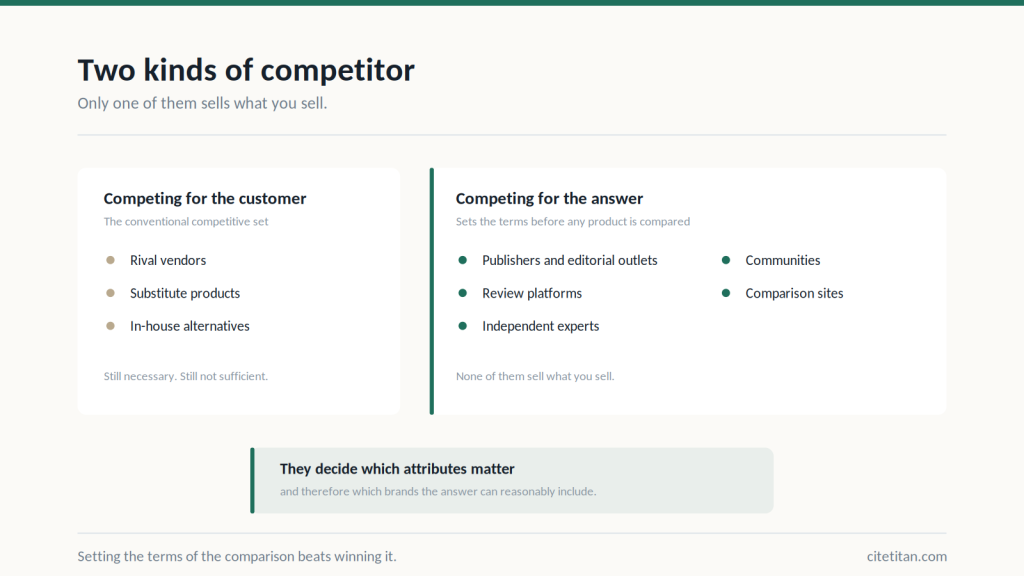
Conventional competitive analysis identifies the brands competing for the same customers. That remains necessary. But it doesn’t surface who’s competing for influence over the answers those customers encounter before they decide.
In AI-mediated search, the entities shaping a commercially important answer can include publishers, editorial outlets, review platforms, independent experts, and communities, none of which sell what you sell, but all of which can shape how the category gets framed, which attributes get emphasized, and which brands get included or passed over.
The competitive question isn’t who else appears in the answer. It’s what that entity establishes about the category that the AI answer then inherits and whether that framing works against the brand’s position before a single product gets compared.
A publication that consistently defines which attributes matter most in a category is doing something more significant than outranking a competitor. It’s setting the terms on which the competition happens.
Where to draw the line
The risk is expanding the competitive set until it becomes unworkable, with everything appearing in an answer treated as a threat. A grounded boundary: an entity that repeatedly occupies a role that shapes how the business’s customers decide. Something appearing occasionally in peripheral answers isn’t necessarily competing for anything that materially moves revenue. Something that consistently shapes how a high-intent question gets answered is a different situation entirely.
Attention shifts from cataloguing everyone who appears to understanding which entities are shaping how the relevant decision gets framed before the brand even enters the picture.
The brand’s website is one input, not the whole picture
When visibility falls short, the organizational response is often to produce more content: more articles, more landing pages, or more structured data. Sometimes that’s right. Sometimes it addresses a different problem from the one that exists.
For search-enabled AI systems, the sources drawn on when constructing an answer can extend well beyond what a brand publishes about itself.
Reviews, editorial coverage, comparison content, expert references, and community discussions can reinforce a brand’s positioning, contradict it, or simply fail to establish it at all.
The gap between internal clarity and external reality
A company can have sharp internal clarity, well-defined positioning, documented differentiators, and articulated use cases, while the market holds a much messier picture.
Internally, everyone knows what the brand does best and why customers choose it. Externally, customers describe it one way, reviewers emphasize something else, third-party sources associate it with a different use case, and what’s out there may be reinforcing a competitor’s claim to the position the brand wants to own.
Publishing more pages from the company’s own perspective doesn’t necessarily resolve that. A brand controls what it publishes. How customers describe it, what reviewers emphasize, what publications associate it with, and which category the market places it in all sit outside that control. Confusing the two is where content investment quietly disappears.
The question isn’t about volume. It’s what the available information, owned and external together, allows the market to conclude about this brand.
If what’s out there is thin, contradictory, or silent on what separates the brand from its competitors, publishing more of the same may not close that gap. The problem isn’t necessarily content. It’s that the evidence needed to establish the brand’s position may not yet exist or may not yet be strong enough outside the brand’s own properties.
Diagnose the failure before choosing the response
AI visibility problems aren’t all the same problem. Applying standard interventions regardless of what’s failing is how organizations can spend significantly and still see little change. The failure modes below are ways to distinguish the problems, and knowing which one applies changes what gets done next.
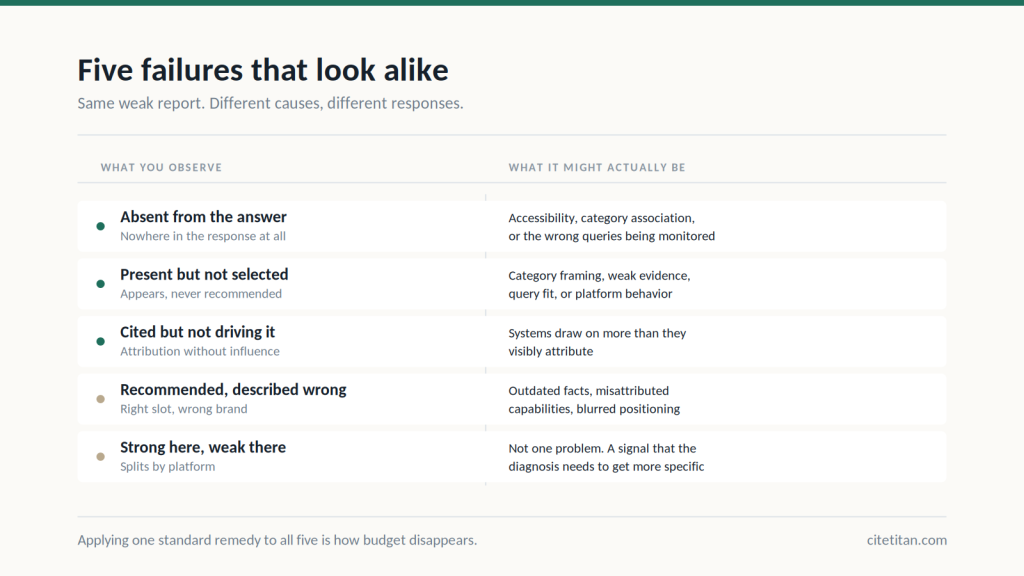
Absent from the answer
Absence can point in several directions: the content isn’t accessible or relevant to how the question is being asked; the brand isn’t clearly associated with the category in available sources; the queries being monitored don’t reflect how people ask questions in this space. Each points somewhere different, and producing more content speaks to only the first.
Present but not selected
Appearing without being recommended isn’t automatically a positioning failure, though it can be. It might involve how the category is being framed, the strength of available evidence, query-specific fit, or platform behavior worth understanding before drawing conclusions. What’s visible narrows the possibilities. It doesn’t confirm the cause.
Cited but not driving the recommendation
A citation tells us a source was visibly attributed. It doesn’t tell us how much that source shaped the answer or whether the user’s decision followed from it.
Search-enabled AI systems can access more relevant material than they ultimately cite, so what a system draws on and what it visibly attributes aren’t necessarily the same set.
Citation counts are therefore an incomplete read on how sources factor into what gets recommended, a number that can move without telling you whether the outcome it’s supposed to represent has moved with it.
Recommended but described incorrectly
Showing up in answers based on outdated information, misattributed capabilities, or blurred positioning can be worse than not showing up; the brand gets recommended for something it no longer does, may never have done, or may do less well than alternatives.
Accuracy and consistency across the relevant sources can address this. Volume alone doesn’t.
Strong in one place, weak in another
The cited-source landscape can significantly differ from one AI platform to another, with many sources appearing in one place but not another even when the questions and category are similar.
Recommendation patterns that are strong on one platform and weak on another don’t necessarily point to a single problem; they’re a sign the diagnosis needs to get more specific, because what’s working in one place doesn’t transfer by assumption.
Put the effort where it can change something
The error that drains the most resources in AI search isn’t failing to appear. It’s treating a visible outcome as something that can be directly engineered, as if adjusting an input reliably shifts the output the way changing a title tag changes what shows in a search result.
The relationship between an input and an AI-generated answer is difficult to observe directly, varies across platforms, and doesn’t lend itself to the predictable input-output assumptions marketers often make about conventional search. That changes where effort should go.
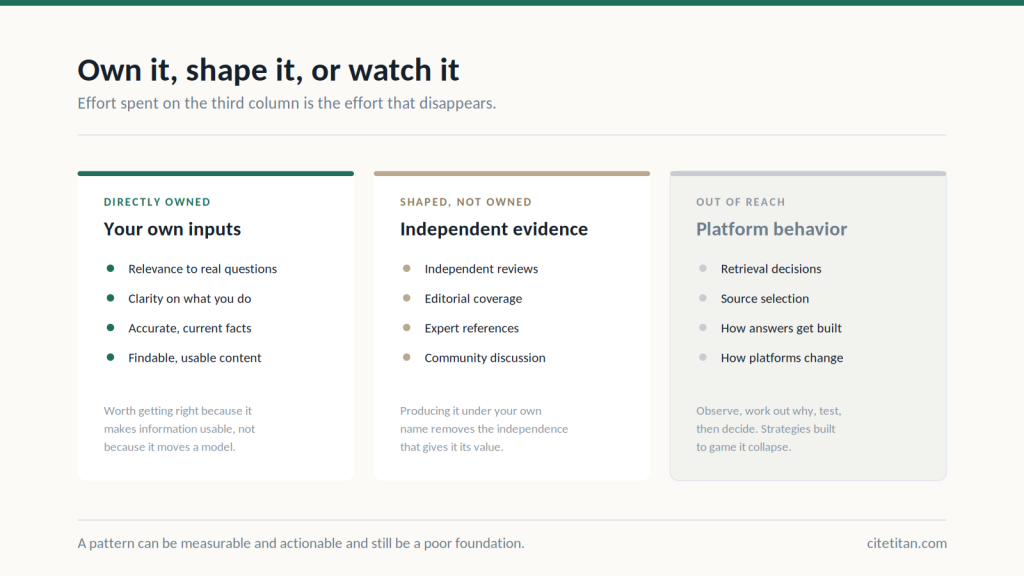
What the business owns
The inputs a business directly governs include how relevant and specific its content is to the questions it needs to be part of, how clearly it articulates what it does and for whom, whether its factual information is accurate and current, and how easy its content is to find and use.
These are directly controllable inputs, and they’re worth getting right because they make information more useful and accessible, not because each has been shown to move model behavior in a predictable direction. Losing sight of that leads back to an AI ranking factors list, just framed differently.
When the diagnosis points to inaccuracies in how the brand is being described or gaps in how clearly it’s associated with the category, this is where to start. Getting these wrong can undermine much of what gets built on top of them.
What it can shape but doesn’t own
Independent reviews, editorial coverage, expert references, and relevant community discussion sit outside the brand’s direct authorship but inside what gets drawn on when answers get constructed. A business can create circumstances that make this kind of external evidence more likely: through differentiation strong enough that third parties have something to write about, and through showing up in conversations the category actually has.
If the owned information is already in good shape, and the failure modes from the previous section don’t explain the gap, independent evidence is where the investigation should turn next. The right investment may be in what generates that evidence externally, not in more owned content that the surrounding sources don’t yet support. Producing this evidence under the brand’s own name removes the independence that gives it particular value.
What it can only watch and learn from
Retrieval decisions, source selection, how answers get constructed, and how platforms behave sit outside direct reach. Strategies built around gaming them tend to collapse when the ground shifts. Observe what’s happening, work out why, test it, then decide. That sequence holds up better than building around a pattern that may not last.
Measure what’s there to measure
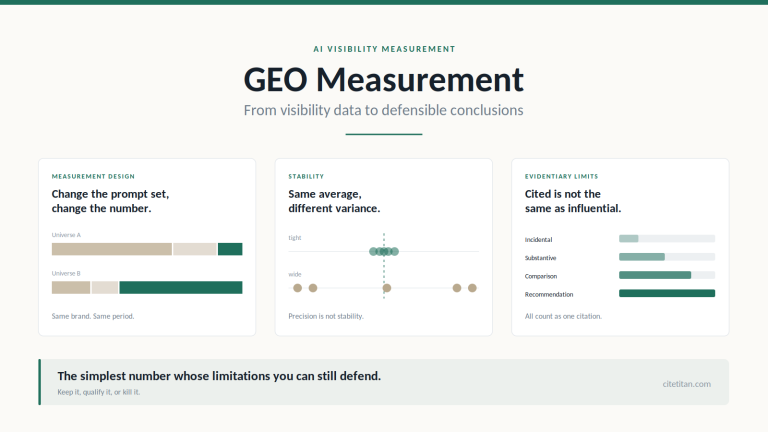
The measurement problem in AI search isn’t finding a sharper visibility score. It’s working out whether a given metric can tell real change from normal variation reliably enough to act on. A measurement system can become more precise without becoming more truthful, and in that gap, decisions get made on numbers that look rigorous and aren’t.
Are we tracking the right queries?
A metric can be carefully tracked while pointing at the wrong question.
- Are the queries being monitored ones where the brand needs to show up before a purchase decision gets made?
- Are they generating numbers from informational questions with little direct connection to a commercial decision?
- Is the metric capturing whether the brand is being recommended or just whether it appeared?
Mixing high-intent and purely informational queries into a single score can make both harder to read and easier to misrepresent as progress.
Can we tell a signal from variation?
AI-generated answers can vary even when the apparent query and platform are held constant.
A visibility number drawn from a small fixed query set at a single point in time on one platform is picking up noise alongside whatever real pattern exists.
Before concluding something has improved, the question is whether the measurement approach can distinguish a genuine shift from ordinary variation because if it can’t, the number can show movement regardless of whether anything has changed.
Does it connect to purchasing decisions?
A brand appearing prominently in general category answers but weakly in answers to questions people ask right before they buy has a reporting problem if it’s treating the former as evidence of the latter. A precise-looking number built on a poorly defined question doesn’t get more trustworthy through consistent tracking. It gets more dangerous because it looks like it’s saying something it isn’t.
A metric that isn’t relevant to a decision doesn’t become more useful by becoming more precise. At that point, refining it is its own proxy problem.
Don’t build the strategy around a pattern that can move
One of the trickier errors to catch in AI search is building durable plans around patterns that may be temporary by nature: a source type appearing frequently in citations right now, a content format showing up consistently this quarter, or a platform behaving predictably today.
A pattern can be measurable and actionable while still being a poor foundation for strategy.
Reddit provides a useful example of how quickly a source’s citation prominence can change. Daily tracking by Promptwatch recorded its share of ChatGPT Search citations falling from a steady 3.83 percent to 0.52 percent within days in August 2026, an 86 percent relative drop, while Google’s AI Overviews moved only about 11 percent over the same window. The tracking shows when the change happened. The reason for it was never established with the same confidence.
For anyone who had built strategy around Reddit’s citation prominence, that kind of shift would create a problem they could no longer diagnose from the observable change alone.
AI systems can also arrive at broadly similar answers while relying on substantially different visible sources.
Agreement on the answer doesn’t require agreement on the sources, which means optimizing around one platform’s citation patterns creates a strategy whose usefulness may not transfer to another platform, may not persist, and may tell you little about the conditions producing the outcome elsewhere.
What tends to hold
Platform behavior, retrieval patterns, and source preferences shift. Useful and accurate information, clear positioning, credible independent coverage, consistent description across sources, and the discipline to notice when something has changed tend to be more durable.
They aren’t permanent levers on model behavior. They’re what gives a brand a stronger foundation for being found and represented accurately as things change around it.
Current patterns are worth acting on when the opportunity is real, testable, and the economics make sense. The line is between exploiting an opportunity and mistaking it for a foundation. Observe, work out why, test it, decide, and stay positioned to adjust when the pattern moves.
What this asks of the business
Where a brand appears relative to decisions that drive the business, and how accurately it’s represented when it does, those are the questions that can go unasked.
Start with the bottleneck that most limits visibility where it can affect the business. If inaccurate or ambiguous representation is the bottleneck, address it first because it can affect what gets built downstream.
If representation is sound, investigate high-intent recommendation gaps, where the brand needs to be part of the consideration set and isn’t. If the owned information is already strong and those gaps remain unexplained by query, relevance, or platform issues, examine whether independent coverage is the missing piece.
Only then should platform-specific opportunities take priority and only where the commercial case is clear. Broad informational presence that doesn’t connect clearly to decisions deserves less attention than it typically gets.
Being honest about what the business controls directly, what it can shape from a distance, and what it can only watch and respond to: that’s where the diagnosis has to start. And having a measurement approach clear enough to show whether any of it is working is what keeps the effort from becoming its own proxy problem.